

For decades now, shortwave technology from Rohde & Schwarz has ensured communications between the Italian Antarctic research stations and their homes
Far from civilization, there are only two options for long-distance communications: satellite or shortwave radio. Modern satellite phones are about the same size as a mobile phone. They represent the only option for mobile operation in remote areas.
However, for stationary operation in locations with electrical power, there is a viable alternative: shortwave radio. The benefits include zero connection charges, freedom from infrastructure and round-the-clock availability.
Of course, in a hostile environment far from civilization, it is not a bad strategy to use both options in order to have a backup available. This is exactly the policy at the two Antarctic stations operated by the Italian government. When satellites are in range (not the case in polar regions at all hours of the day), the satellite option is used. Otherwise, there is shortwave radio as a fallback option – based on technology from Rohde & Schwarz.
tttt
ENEA relies on professional equipment
Back in 1988, the Italian National Agency for New Technologies, Energy and Sustainable Economic Development (ENEA) equipped the Mario Zucchelli Antarctic Research Station located in Terra Nova Bay (Ross Sea) with shortwave technology from Rohde & Schwarz. ENEA purchased a 1 kW R&S®XK859C1 transceiver, a 150 W R&S®XK852C1 transceiver and an R&S®EK890 receiver – the top-of-the-line products at that time.
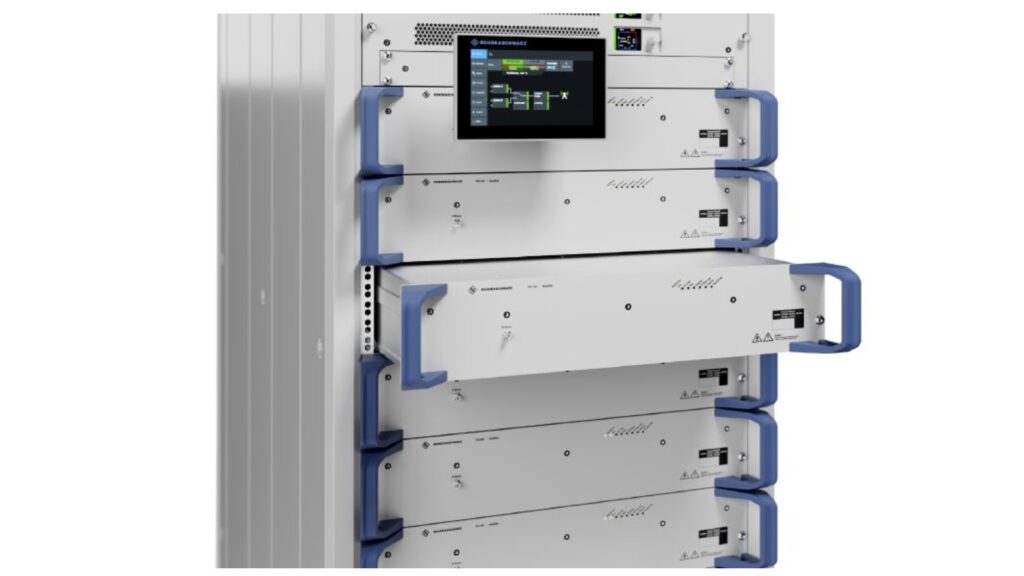
Based on positive experience with this technology, the Concordia Station, which is jointly operated with France, was similarly outfitted 14 years later with shortwave equipment from Rohde & Schwarz. Initially in operation only during the summer months, the station was equipped with one R&S®XK852C1 and one R&S®XK2100L transceiver (each with 150 W). In early 2019, a 1 kW transceiver from the M3SR®Series4100 family was added.
t
Shortwave radio provides independence
Amateur radio products were also tested during this time period, but they fell victim to the local climatic conditions, where the average temperature is –54.5 °C. In contrast, Rohde & Schwarz radio technology – developed for the army and navy in line with stringent MIL standards – does not succumb to environmental hazards so easily.
Although shortwave radio still has a sort of romantic appeal, state-of-the-art radio technology operates on a different plane altogether. What once required significant expertise on the part of the radio operator ‒ since shortwave performance is highly dependent on atmospheric conditions ‒ is now managed by the radio processor to automatically ensure an optimal radio link.
Digital waveforms for voice and data transmission can also be adapted to the medium. Only the transmission rate is subject to physical limits associated with the small available bandwidth. Advanced waveforms allow a rate of about 20 kbit/s. Shortwave is the only medium that can be used to realize worldwide point-to-point connections without repeater stations.
vgvhg
Reliable climate forecasting more urgent than ever
The Concordia Research Station is located 3233 m above sea level on the Antarctic Plateau at a site known as Dome Concordia (Dome C). The station is jointly maintained by the French and Italian polar programs. Along with the Russian Vostok Station and the American Amundsen-Scott South Pole Station, it is the third Antarctic research station that is constantly manned.
In the 1990s, Dome C was selected by the European Project for Ice Coring in Antarctica (EPICA) as part of efforts to find the oldest ice on earth. The objective was to reconstruct the climate history of the earth and improve forecasting of future climatic developments.
ghgjhjbjb
Hunting for ancient ice
Drilling performed from 1996 until the end of 2004 reached a depth of 3270 m, which was only a few meters from the bedrock. The oldest ice sample that was obtained is about 800,000 years old.
Based on analysis of the geological archive, however, we know that prior to the so-called middle Pleistocene transition (i.e. immediately before on a geological timescale), cold (glacial) and warmer (interglacial) ages alternated every 40,000 years. Afterwards, the alternation period increased to about 100,000 years.
The reason for this change is unknown, and therefore represents a topic of current research by Concordia scientists, including representatives of the Alfred Wegener Institute for Polar and Marine Research in Bremerhaven. Rock samples offer no clues, since they do not contain any residual gases. As a result, it is necessary to look deeper into the ice in chronological terms.
gygggg
Localizing the search area
Finding suitable drilling locations was the previous stage milestone for the EPICA follow-up mission “Beyond EPICA – Oldest Ice (BE-OI)”. Researchers are now hoping to find what they are looking for. Only about 40 km from the station, an area with a diameter of 3 km has been identified. Drilling will not begin until 2021 and will be initially limited to a depth of 100 m in order to test the technology.
By 2024/2025, however, the goal is to completely penetrate the ice sheet at the drilling site, which has a depth of 2750 m. This will be followed by the evaluation process, requiring an additional year. In addition to the Europeans with their BE-OI project in the vicinity of Dome C, other teams are also working to break through the one million year mark, including the Japanese at Dome Fuji and the Chinese at Dome A. The International Partnerships in Ice Core Sciences (IPICS) was formed to encourage friendly competition in this race.